
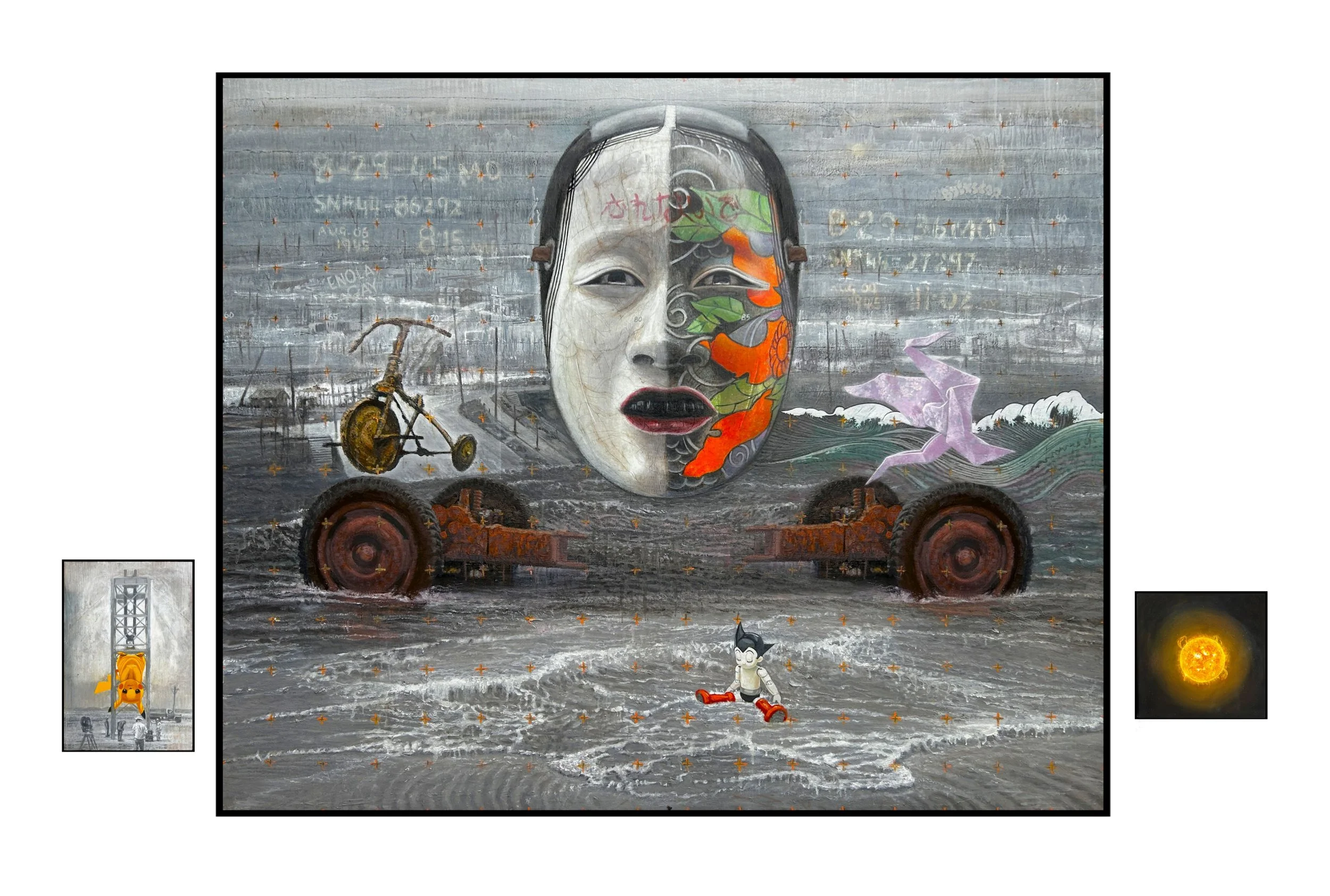
Shinichi’s tricycle. Oil on canvas and oil on masonite board. 153cm x 274cm. 2026
Seconds to Midnight. Foyer Gallery -
Burrinja Cultural Centre, Upwey Victoria
featuring Min Simankevicius and Steven Warburton
Eighty years ago, the atomic bombings of the Japanese cities of Hiroshima and Nagasaki set a new precedent in modern warfare and human suffering.
Local artists Steve Warburton and Min Simankevicius both have responded to the events with recent artworks, retelling the story.
By utilising symbolic and iconic imagery they have constructed multi-layered works in oil and photographic manipulation which seek to comprehend the unfathomable. Their works bear witness to a chapter in history that casts a long shadow upon us and poignantly remind us of the continuous existential threat humanity is facing.
Historical Context
courtesy of Burrinja.
‘Bomb’s away’ - at 8:15am on 6 August 1945 the United States of America dropped an atomic bomb on the unexpecting city of Hiroshima. The destruction of the city was complete. Tens of thousands of people died instantly, many more in weeks and months to come.
Through acts of visual reconstruction, Simankevicius creates works that function as speculative propositions rather than conclusions, inviting viewers to reconsider established truths and engage with the instability of history, memory, and representation.
Three days later a second bomb was dropped on Nagasaki forcing the Japanese Government to surrender and bringing about the end of WWII in the Pacific. These were the only times atomic weapons have ever been used.
Since 1945, over two thousand nuclear bombs have been tested globally, atmospherically and underground. Nine countries possess nuclear weapons that can destroy the world many times over: USA, Russia, Britain, France, China, India, Pakistan, Israel, and North Korea.
Despite an interactional agreement to disarm expressed in the Non-Proliferation Treaty (1968) and a United Nations Treaty on the Prohibition of Nuclear Weapons (2019) these states continue to maintain, diversify and modernise their nuclear arsenals.
Following WWII, the independent organisation Bulletin of Atomic Scientists invented the Doomsday Clock, a symbolic measure of the likelihood of human-made global catastrophe. As of 27 January this year, the clock stands at 85 seconds to midnight. The closest it has ever been.